
Practical AI Automation, Without the Hype
Most AI projects stall because they start with the technology instead of the workflow. Here's the boring, reliable way to actually ship automation that pays for itself.
By Ali Kolachi
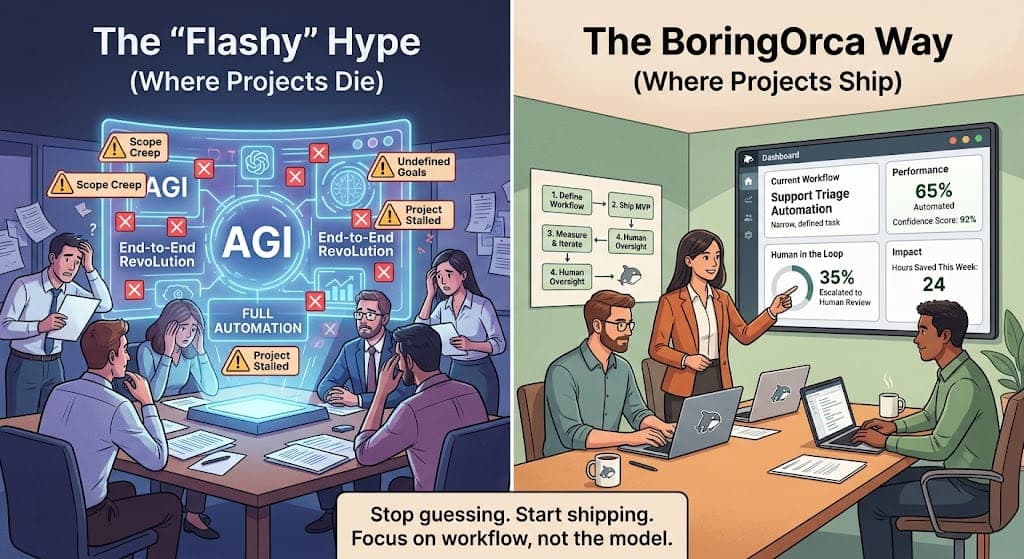
Everyone wants "AI" right now. Far fewer people want the unglamorous work of figuring out which task, for whom, and how you'll know it worked. That gap is where most AI projects quietly die.
At BoringOrca we take the boring route on purpose, because the boring route is the one that ships. Here's how we think about it.
Start with a workflow, not a model
The wrong question is "how can we use AI?" The right question is "which repetitive, high-volume task is costing my team hours every week?" Answer that first, and the technology choice mostly makes itself.
Good candidates share a few traits:
- They happen often — dozens or hundreds of times a week.
- They're rule-ish but fuzzy — too nuanced for a simple script, too repetitive for a senior human.
- They have a clear definition of done — you can tell whether the output is right.
Support triage, document extraction, and first-draft generation all fit. "Replace our analysts" does not.
Ship the smallest useful version
The fastest way to lose momentum is to try to automate the entire workflow at once. Instead, pick the narrowest slice that still delivers value and put it in front of real users in weeks, not quarters.
The goal of the first release isn't to be impressive. It's to be trusted.
A narrow, reliable automation that handles 60% of cases and cleanly escalates the rest beats an ambitious one that's wrong 10% of the time and erodes everyone's confidence.
Put a human where it counts
The best automations aren't fully autonomous — they're well-supervised. Confidence scoring, human-in-the-loop review for high-stakes actions, and clean escalation paths are what make AI safe to deploy in a real business.
This is also what makes it boring in the good sense: predictable, auditable, and calm.
Measure before and after
If you can't point to hours saved, tickets deflected, or errors avoided, you don't have an automation — you have a science experiment. We instrument every project so the value is visible, not vibes-based.
None of this is flashy. That's the point. Reliable AI automation is mostly good judgment about where to apply it and the discipline to ship small and measure. Do that, and the results speak for themselves.
